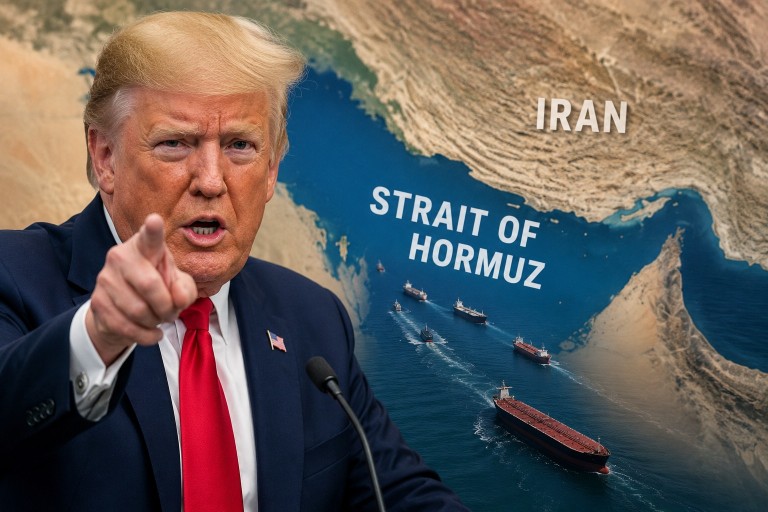
In a recent address in New York, US President Donald Trump announced the potential declaration of the Strait of Hormuz as “a territory of the United States,” amid ongoing tensions and stalled negotiations with Iran. Trump indicated that this declaration could happen “pretty soon” following a US victory over Iran. He asserted that the US already exerts control over this crucial maritime passage through a blockade. The Strait of Hormuz plays a vital role in global trade, facilitating the passage of about 20% of the world’s seaborne oil. This strategic waterway, located between Iran and Oman, has seen restricted access since US and Israeli military actions against Iran commenced.
The ambiguity surrounding Trump’s remarks leaves it unclear whether they reflect an impending shift in US policy or serve merely as rhetorical posturing. Iran, in response, has firmly dismissed the US threats. Kazem Gharibabadi, Iran’s Deputy Foreign Minister, emphasized that Tehran will not succumb to US pressure and maintains the authority over decisions regarding the strait’s status. Furthermore, Iranian Foreign Minister Abbas Araqchi clarified that while messages are being exchanged through intermediaries like Qatar and Pakistan, these do not amount to formal negotiations with Washington.
Iran has outlined specific conditions that need to be met before it considers reopening the strait for shipping. These include demands for compensation for damages inflicted during wartime, the lifting of economic sanctions, and the release of frozen assets belonging to Iran. The ongoing conflict and resultant shipping disruptions have caused a spike in fuel prices, affecting consumers worldwide. President Trump has defended these rising costs, arguing that the increased expenses are a worthwhile trade-off to prevent Iran from developing nuclear weapons.
The continued impasse over the Strait of Hormuz has triggered global concerns regarding energy supply stability and the broader economic repercussions of the conflict. As the situation unfolds, the international community remains on edge, closely observing potential developments that could impact energy markets and geopolitical dynamics.