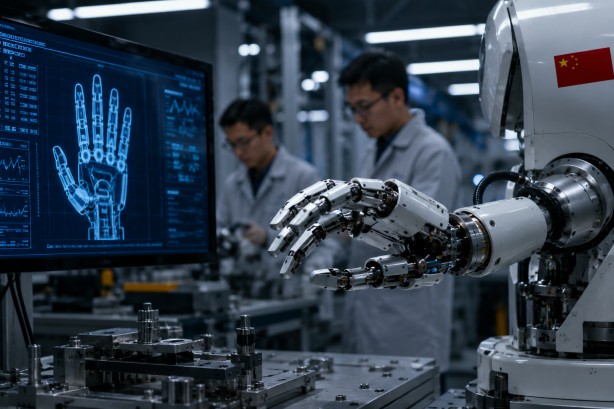
Chinese companies are ramping up efforts to tackle one of the most significant challenges in humanoid robot development: creating highly dexterous robotic hands. Startups across the nation are leveraging artificial intelligence in conjunction with China’s robust manufacturing prowess to engineer robotic hands that can perform intricate tasks like grasping objects, using tools, and handling routine activities. This technology is anticipated to become vital in making humanoid robots practical for use in households, healthcare, and various industries.
Experts highlight that replicating the human hand’s flexibility and precision is far more complex than constructing the rest of a humanoid robot. Developers are tasked with overcoming both hardware hurdles, such as compact motors and sensors, and software challenges that enable robots to comprehend touch, pressure, and complex movements. This dual-front approach is crucial for producing robotic hands that can function effectively in real-world scenarios.
China’s position as a global leader in robotics manufacturing is bolstered by its advanced supply chain and a government-endorsed focus on “embodied AI.” This supportive environment has spurred rapid innovation within the country’s expanding robotics ecosystem. Companies are actively working on developing robotic hands, wearable sensor gloves, and AI systems that learn human movements through real-world data collection, thereby advancing the field significantly.
Researchers assert that enhancing the dexterity of robotic hands marks a pivotal step toward creating robots capable of executing a diverse array of everyday tasks. These tasks range from household chores to industrial work and even advanced prosthetic applications. The progress in this area is seen as a gateway to more practical and versatile humanoid robots.
Industry leaders are optimistic that ongoing advancements in AI and robotics will eventually allow humanoid robots to integrate more seamlessly into human environments. This evolution is expected to unlock new opportunities across various sectors, including manufacturing, healthcare, and consumer services, ultimately leading to a future where robots operate more naturally alongside humans.