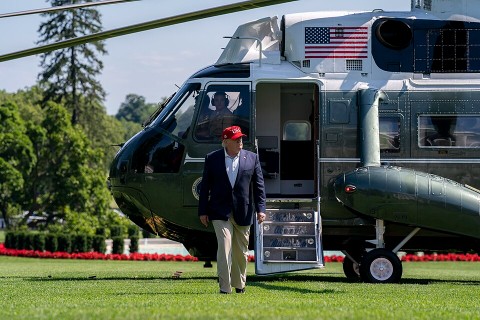
In a move that could potentially strain diplomatic ties with China, former President Donald Trump has expressed his intention to speak with Taiwan’s President Lai Ching-te. Speaking with reporters at Joint Base Andrews in Maryland, Trump stated his willingness to address the “Taiwan problem,” a comment that resonates with Beijing’s perspective on the issue. This statement marks the second time in a week that Trump has mentioned plans to communicate with Lai, following a recent meeting with Chinese President Xi Jinping. Currently, no call has been scheduled between the two leaders, and neither the White House nor the Chinese embassy in Washington has commented on potential discussions or timelines.
The prospect of a direct conversation between U.S. and Taiwanese leaders is particularly significant given that no such talks have occurred since the U.S. shifted its diplomatic recognition from Taipei to Beijing in 1979. However, Trump previously broke this diplomatic norm in late 2016 when he spoke with then-Taiwan President Tsai Ing-wen, leading to a formal complaint from China. Trump’s administration has notably increased arms sales to Taiwan, yet he has also hinted at using these sales as a negotiating tool, adding complexity to U.S.-China-Taiwan relations. Meanwhile, Beijing’s government has reportedly linked approval for a Pentagon official’s visit to China with Trump’s decision on a substantial $14 billion arms deal with Taiwan.
Trump’s remarks have generated mixed reactions, especially in Taipei. While President Lai has expressed openness to dialogue with Trump, he emphasizes Taiwan’s commitment to maintaining the status quo and accuses China of destabilizing the region through its military expansion. Lai’s stance reflects the island’s desire to continue its democratic and free way of life, countering China’s claims over Taiwan. Despite Lai’s readiness to engage with Trump, the U.S. president’s characterization of the situation as the “Taiwan problem” echoes Beijing’s language, highlighting the delicate balance in U.S.-Taiwan-China dynamics.
Under U.S. law, Washington is obliged to support Taiwan’s self-defense capabilities, and both Republican and Democratic lawmakers advocate for continued military support to the island. Taiwan holds strategic importance for the U.S., being its fourth-largest trading partner, largely due to its advanced semiconductor exports. These semiconductors are pivotal to the global economy, further underscoring the significance of U.S.-Taiwan economic relations. As Trump navigates these diplomatic waters, his decisions will inevitably influence the future of U.S. interactions with both Taipei and Beijing.