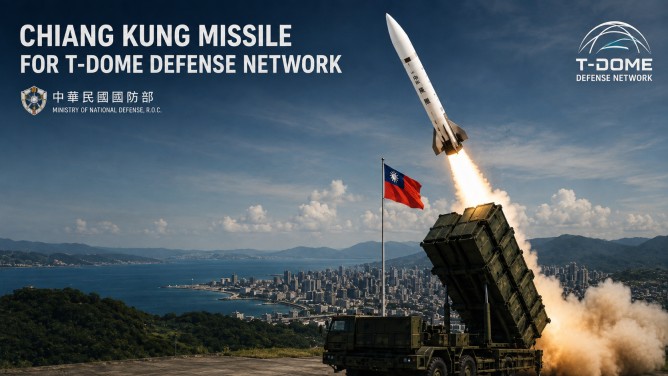
Taiwan is advancing its air defense capabilities with the development of the Chiang Kung missile, a high-altitude interceptor poised to become a pivotal component of the island’s proposed “T-Dome” integrated air defense system. Officially known as Tien Chien IV, this missile is engineered to intercept ballistic missiles at altitudes reaching up to 70 kilometers. Utilizing a land-based vertical launch system, the Chiang Kung employs a two-stage solid-propellant rocket with vectored thrust, which enhances its maneuverability at high altitudes.
The National Chungshan Institute of Science and Technology (NCSIST), responsible for the missile’s development, highlighted its radar’s capability to detect a variety of targets and engage multiple tactical ballistic missiles simultaneously. This is possible even when operating amidst electronic warfare threats. The system is also equipped with a mobile active electronically scanned array radar, designed to remain effective in environments affected by electromagnetic interference and GPS jamming.
Currently, Taiwan lacks a comparable high-altitude interception capability, and the introduction of the Chiang Kung missile is expected to bridge this gap. It is intended to work alongside existing air-defense systems as part of the envisaged T-Dome network, enhancing the overall defensive posture of Taiwan against potential missile threats.
Despite its strategic importance, the Chiang Kung missile program faces financial hurdles. Notably, the missile was omitted from Taiwan’s main defense budget, leading the Ministry of National Defense to pursue funding through a supplementary budget. Officials have indicated that any delays in securing this funding could potentially disrupt the acquisition timeline and impact the broader development of the T-Dome air defense network.